
Executive Summary
Water for Injection (WFI) is a critical component in pharmaceutical, biopharmaceutical, and medical device industries, requiring stringent control of impurities such as Total Organic Carbon (TOC) to ensure product safety and efficacy. This white paper explores the phenomenon of TOC increase in bulk packaged WFI over time, primarily due to the leaching of organic compounds from packaging materials. It highlights how this effect varies with packaging size, influenced by the surface area-to-volume ratio, with smaller containers exhibiting greater relative TOC contributions from leaching.
Drawing on Aquabiliti's expertise as a manufacturer of single-use bioprocess containers, this document discusses the inevitability of packaging-related leaching while emphasizing that such contributions remain well below USP <643> specifications of 8,000 ppb across all product sizes during real-time stability studies. Results from Leachables and Extractables (L&E) studies confirm that leached organics are either below reportable limits or deemed non-harmful. Aquabiliti's in-house manufacturing control enables superior initial product purity but the influence of packaging on TOC levels remains inherently inevitable. By understanding these dynamics, customers can better appreciate the balance between regulatory allowances and practical packaging considerations.
Introduction
In the pharmaceutical, biopharmaceutical, and medical device industries, Water for Injection (WFI) serves as a foundational excipient for drug formulation, cleaning, and processing. Produced under rigorous standards, WFI must meet pharmacopeial requirements for purity, including limits on Total Organic Carbon (TOC), which measures the aggregate concentration of carbon-based impurities that could potentially affect product stability or patient safety.
TOC in WFI can originate from various sources, including raw materials, production processes, and – critically – post-production packaging. While WFI generation systems are designed to achieve low TOC levels (i.e., <500 ppb per USP <643>), packaged WFI is subject to higher allowable limits (<8,000 ppb) to account for inevitable interactions with packaging materials. This white paper from Aquabiliti examines the temporal and size-dependent increase in TOC due to organic leaching from packaging in bulk WFI products. As a vertically integrated manufacturer of single-use bioprocess containers, Aquabiliti offers unique insights into mitigating these effects while ensuring compliance and product integrity.
Aquabiliti provides bulk WFI in a range of sizes – 10L, 20L, 50L, 100L, 200L, and 1,100L – packaged in proprietary single-use bioprocess containers. These containers are engineered for sterility, compatibility, and minimal extractables, yet, like all polymeric materials, they contribute trace organics over time. The following sections delve into the mechanisms, variations, and regulatory context of this phenomenon.
Mechanisms of TOC Increase in Packaged WFI
Organic Leaching from Packaging Materials
Packaging materials, particularly polymers used in single-use bioprocess containers, are composed of complex formulations including base resins, additives, and processing aids. Over time, these components can leach into the contained WFI, introducing organic carbon and thereby elevating TOC levels.
Leaching is a diffusion-driven process influenced by factors such as temperature, storage duration, and the chemical affinity between the packaging material and the aqueous solution. In WFI, which is ultrapure and lacks buffering agents, even minute quantities of leached organics can be detectable. Studies have shown that TOC levels in packaged WFI typically stabilize after an initial increase, reflecting an equilibrium between leaching rates and degradation or adsorption of organics.
Importantly, Aquabiliti's Leachables and Extractables (L&E) study demonstrated that leached compounds are either below reportable limits (e.g., <0.1 ppm for most analytes) or pose no toxicological risk based on safety assessments. These studies involve exaggerated extraction conditions, using elevated temperatures and solvents, to identify potential leachables. Results confirm that while leaching contributes to TOC, the specific organics are non-harmful and do not compromise WFI suitability for biopharmaceutical applications.
Temporal Dynamics of TOC Elevation
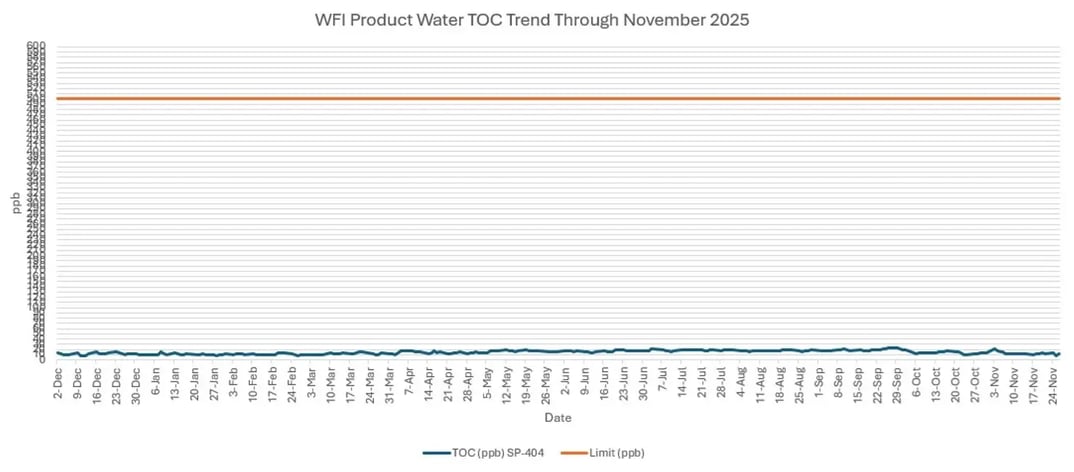
Real-time stability data for Aquabiliti's bulk packaged WFI products reveal an initial increase in TOC post-packaging followed by a gradual increase over shelf life, attributable primarily to packaging interactions. Aquabiliti’s continuous online monitoring of TOC supplied by the WFI generation system has historically been <20 ppb but once packaged can increase by 100 – 1000 ppb depending on container size. Over months of storage at ambient conditions, TOC may rise modestly but remains far below the USP <643> limit of 8,000 ppb.
This temporal profile aligns with industry observations: early-stage leaching is more pronounced as surface-bound organics migrate into the solution, tapering off as concentrations equilibrate. Aquabiliti's in-house production of bioprocess containers allows for optimized film formulations that minimize initial extractables, resulting in slower TOC accumulation compared to third-party sourced packaging.
Impact of Packaging Size on TOC Variability
A key variable in packaging-induced TOC increase is the container size, governed by the surface area-to-volume (SA/V) ratio. Smaller volumes have proportionally larger contact surfaces per unit of WFI, amplifying the relative impact of leaching.
For Aquabiliti's 20L container, higher SA/V leads to greater per-volume TOC contribution from leaching. For the 1,100L container, lower SA/V dilutes the leaching effect across a larger volume.
Stability data across Aquabiliti's product line illustrate this: TOC increases are more noticeable in smaller sizes during extended storage, yet all remain compliant with the USP requirement of <8,000 ppb. The chart below details the real-time stability data for all product size offerings collected thus far:
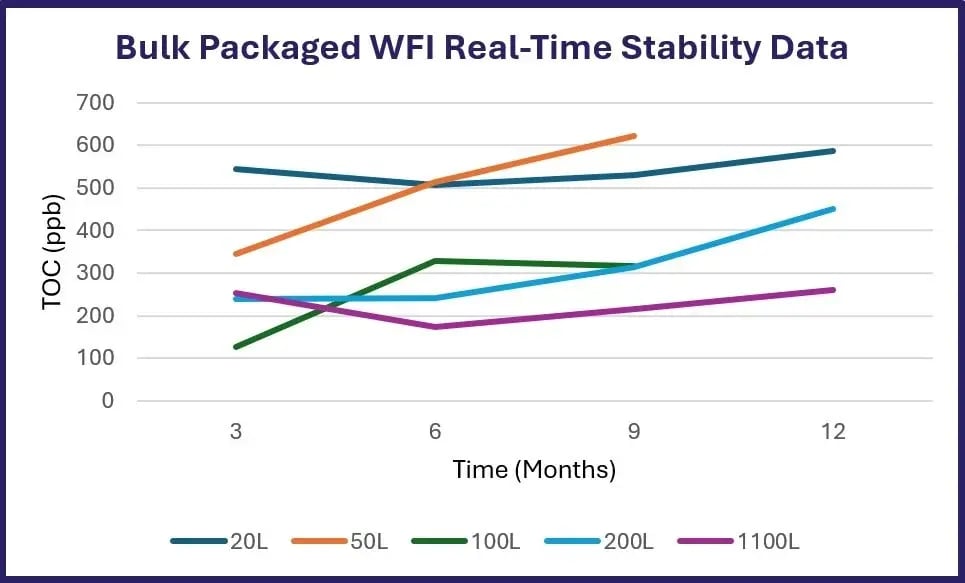
This gradient underscores the importance of size-specific stability monitoring. Smaller packages, with their elevated SA/V, serve as conservative indicators for larger ones, which is why Aquabiliti uses 1L sample bags (even smaller than commercial products) for batch release testing to report the highest possible TOC on CoAs.
Comparative TOC Performance: Aquabiliti WFI vs Market SWFI Products
The influence of container size on TOC is further highlighted when comparing Aquabiliti's bulk packaged WFI to commercial 1L IV-bagged Sterile Water for Injection (SWFI) from two prominent providers. Testing of such 1L SWFI products approximately one-year post-manufacturing revealed TOC levels of 3,052 ppb and 4,505 ppb, respectively. While these results comply with the USP <643> specification of 8,000 ppb, they are substantially higher than Aquabiliti's bulk packaged WFI, which typically maintains TOC below 700 ppb even in smaller sizes at 12 months.
Although Aquabiliti's WFI cannot technically be labeled as SWFI – due to container sizes exceeding 1L and its designation for further manufacturing rather than direct parenteral administration – it fully meets the USP purity criteria for SWFI. In fact, Aquabiliti's lower TOC profiles demonstrate superior performance compared to these SWFI products, which are intended for direct patient injection. This comparison highlights that Aquabiliti's bulk packaged WFI not only adheres to but often exceeds the quality benchmarks of patient-facing SWFI and reinforces that the higher SA/V ratio in smaller containers drives greater relative leaching.
Regulatory Context and Aquabiliti's Compliance Strategy
The United States Pharmacopeia (USP) recognizes the practical challenges of packaging interactions, establishing distinct TOC limits: <500 ppb for WFI generation systems to ensure high initial purity, and <8,000 ppb for packaged WFI to accommodate minor contributions from containers. This tiered approach reflects an understanding that absolute zero leaching is unattainable in polymeric systems, yet manageable within safe bounds.
Aquabiliti's vertically integrated model - manufacturing both WFI and bioprocess containers - enables end-to-end control, from design to final packaging. This results in lower initial TOC and predictable leaching profiles (See chart below). Batch release incorporates TOC testing from 1L sample bags, ensuring CoAs reflect worst-case values and providing customers with conservative purity assurances.
Furthermore, Aquabiliti's L&E studies, combined with real-time stability protocols, confirm long-term compliance. No instances of TOC exceeding 8,000 ppb have been observed, even under stress conditions, reinforcing the safety and reliability of the product line.
Conclusion
TOC increases in bulk packaged WFI due to organic leaching are an inherent aspect of polymeric storage systems, modulated by time and container size via the surface area-to-volume ratio. Aquabiliti's comprehensive studies affirm that these increases are minimal, non-harmful, and compliant with USP <643> across all sizes (10L to 1,100L). Through vertical integration and rigorous testing, Aquabiliti ensures initial high purity and predictable stability, bridging the gap between USP's generation and packaging limits.
This understanding enables customers to confidently incorporate Aquabiliti WFI into their processes, minimizing risks and optimizing efficiency. For more information on Aquabiliti’s bulk packaged WFI, please contact us through our website or reach out to our team at customercare@aquabiliti.com.